

Guide: potty training a small breed puppy
Potty Training a Small Breed Puppy: A 30-Day Plan With Crate Training
Potty training a small breed puppy starts the day it comes home. Take it out after every sleep, meal, drink and play session, reward it the moment it finishes, and never punish an accident. Some puppies are reliable within days and others take several months. Small breeds often sit at the slower end because their bladders are tiny.
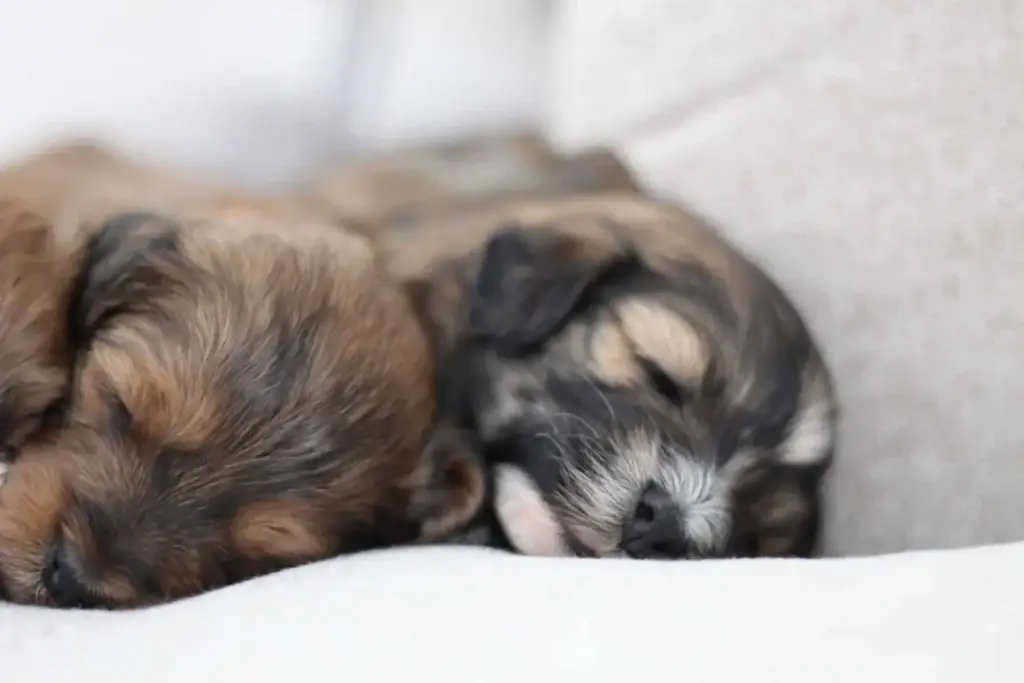
Potty training a small breed puppy: three rules that matter
- Take the puppy out before it needs to ask. A young puppy gives almost no warning. Your schedule does the work until its body catches up.
- Reward within seconds, in the potty spot. Praise and a treat right there, not back inside. The puppy learns where to go, not only that going is good.
- Supervise or confine. A puppy that is loose and unwatched will have an accident, and each accident indoors is practice at the wrong thing.
The American Kennel Club sums up successful housetraining the same way: consistency, supervision, a predictable schedule and rewards (AKC).
When to take a small breed puppy out to potty
The AKC lists these moments. For a very young puppy that can add up to a dozen or more trips a day.
- First thing in the morning and last thing at night
- After every nap
- After time in the crate
- After meals and after drinking
- After play, and after chewing a toy or bone
How long can a puppy hold it?
The AKC’s rule of thumb is about one hour for each month of age. Humane World for Animals gives a similar limit for crate time: no longer than the puppy’s age in months plus one hour, and never more than 3 to 4 hours at a stretch for a puppy under 6 months (Humane World).
| Age | Rough daytime limit | What that means |
|---|---|---|
| 2 months | About 2 hours | Out every 1 to 2 hours while awake, plus one or two night trips |
| 3 months | About 3 hours | Out every 2 to 3 hours. Many puppies start sleeping through the night. |
| 4 months | About 4 hours | Out every 3 to 4 hours |
| 6 months | About 6 hours | Most puppies are close to reliable |
Treat these as upper limits. A toy-sized puppy will often need to go sooner, especially after play.
Crate setup and the first nights
A crate works because dogs prefer not to soil where they sleep. Size matters: big enough for the puppy to stand, turn around and lie down, but not so big that it can use one corner as a toilet. For a small breed, that usually means a small crate or a larger one with a divider.
Humane World for Animals recommends building up in steps:
- Put the crate in a family area with the door open and let the puppy explore it for treats.
- Feed meals inside, closing the door for a little longer each time.
- Practice short stays while you are home, then while you are out of sight.
- Add short absences and overnight sleep, with the crate near your bed at first.
Never use the crate as punishment. For the first week, expect to get up once or twice at night. Keep those trips quiet and businesslike: out, potty, praise, back to bed.
Accidents: what to do and what not to do
- Caught in the act: calmly carry the puppy to its potty spot and reward it for finishing there.
- Found later: clean it up and move on. The puppy cannot connect a scolding to something it did minutes ago.
- Clean with an enzymatic cleaner. Ordinary cleaners leave a scent that draws the puppy back to the same place.
- Never punish. It teaches the puppy to hide from you when it needs to go, which makes training slower.
If a puppy that was doing well suddenly starts having accidents, or goes very often, call your vet. It can be a sign of a urinary infection or a tummy upset.
Pads and bells: potty training options for a small breed puppy
The AKC notes that potty pads can help owners of small dogs, particularly in severe weather or when nobody can get home often enough, and that some trainers teach small breeds to use an indoor potty spot much like a litter box. The trade-off is that pads can make the later switch to outdoors harder (AKC).
Pick one plan and stick to it. If you use pads, keep them in one place, near the door you will use later. A bell on the door is optional; some small dogs take to it quickly as a way to ask.
Ask us what routine your puppy is on when it leaves, so you can carry on with the same one. For the first two days at home, see our new puppy checklist.
Related guides
Sources
- American Kennel Club, How to Potty Train a Puppy
- Humane World for Animals, How to Crate Train Your Dog or Puppy
- Humane World for Animals, How to Potty Train a Puppy
Stuck on something?
Families who bring home one of our puppies can call or text us any time at (801) 414-6659.